Letting Go Of things
I am a natural collector of things; over the past fifteen years or so, I have the natural accumulation of family, domestic artefacts that litter homes up and down the first world. Feeling some guilt at this material hoard, I am currently making the effort to reduce, simplify and streamline the contents of my home. Unfortunately, I once did some dementia training, and learned about the importance of sensory stimuli for maintenance of memories, and so whenever I pick up an item from my home that is chock full of embodied history, I feel pangs of physical pain at the thought of letting go.
It was a fairly straightforward decision to begin archiving these items as a sort of illustrated history of my family life.
In this first image I painted a vase that my eldest son had given me for my 40th birthday during the 2020 lockdown: I had been utterly dismal and miserable because I had hoped for most of my life that one day one of my big birthdays would be celebrated in a grand way. I had always given everyone else as good a birthday as I could muster and when my big day was eclipsed by a virus, and nothing happened for me, I threw all manner of possessions down the garden in a frightened, disappointed rage.
This vase also came to mean that my eldest son had hit maturity; the point at which meaningful gifts are made to a parent suggests to me that there is an adulthood available. I was delighted and consequently the vase has been used frequently. I am the sort of person to bring home armfuls of cow parsley as often as I might enjoy a florists work. The vase recently was broken and although I am not averse to a little kintsugi exercise, the damage was too great. I had to throw the broken pieces away, and that made me sad.
So I have painted it here, just for myself. An illustration that refers to the beautiful flowers that graced it, and to the sweetness of the spirit who gave it to me.
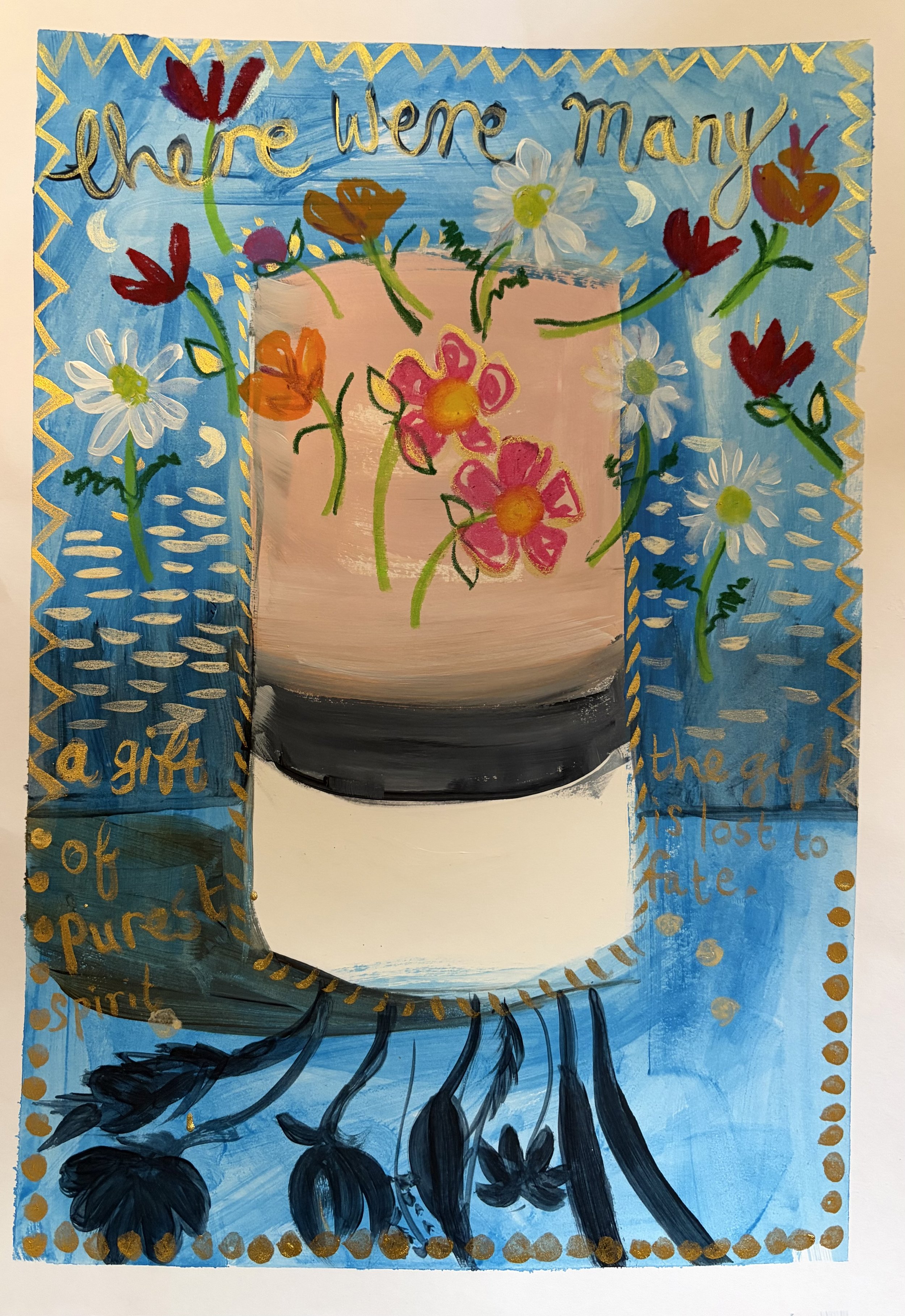
The Vase my eldest Son gave to me for my 40th birthday, that broke recently.
There is great value to the recording and overlaying emotional meaning to an object. As I referred earlier to the embodied history within it, the memories are the precious aspect, the sensory connection with the materiality. The object itself, (in this case, a vase made in a factory for a high street retailer) represents homogeneity, faceless mass production. I can’t separate both realities, but I can honour what it meant to me.
When I work with people therapeutically who are stuck and cannot easily move beyond a stage of life because of the overwhelming amount of material accumulation, I encourage photographic diaries, journal entries and other artistic responses.
Maybe you should give this a go too.
